At jury duty last week we were asked to fill out a questionnaire, below.
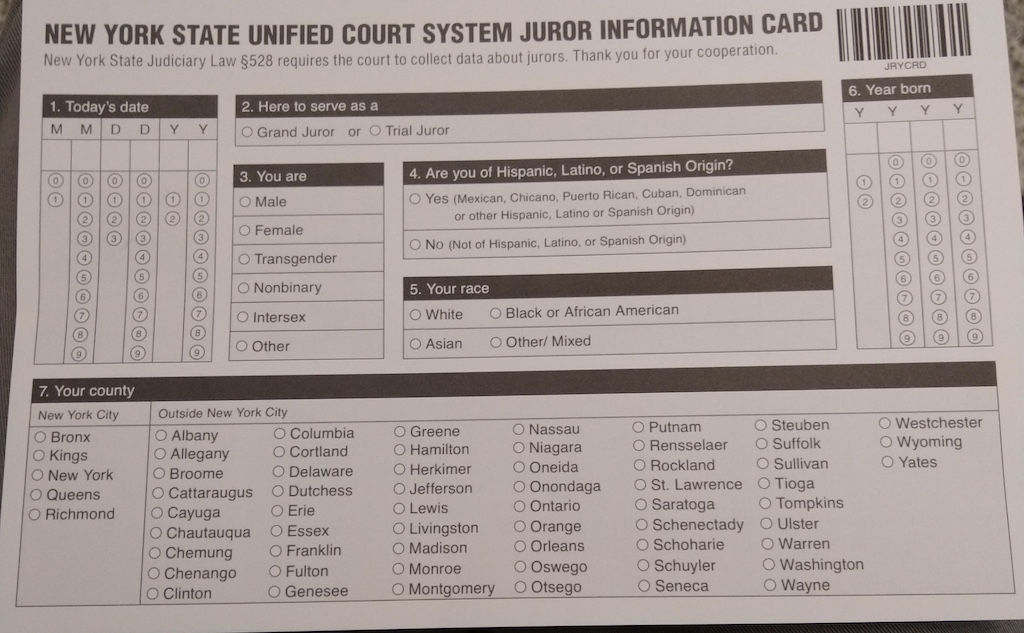
It asked us to answer questions about our gender, race, and level of Hispanicity. It listed the law — New York State Judiciary Law §528 — that allows this data collection.
Let’s unpack this, with an eye towards the sociology of identity politics. What were the Noticings and Wonderings?
Gender
I first noticed gender. There are more choices for gender (male, female, transgender, nonbinary, intersex, and other) than there are for race (white, black or African American, Asian, other/mixed). Which is fascinating, since gender, per se, is biologically determined, whereas race is socially constructed. (Note, we are referring to gender not “gender identity.”)
Race
I next noticed race. Race is the ultimate social construct – there’s more genetic variation within racial groups than between them,. Furthermore, racial categories have changed dramatically over time, and what counts as “white” or “black” varies enormously across countries, cultures, and historical periods.
I wonder: Somehow we’ve arrived at a moment in our society where gender is treated as fluid and self-determined, while race remains largely fixed and policed by social boundaries. I call it The Paradox of Identity Fluidity: Why Gender Boundaries Became Permeable While Racial Boundaries Remained Fixed (thank you, BFF Claude, for suggesting that title).
The Rachel Dolezal case perfectly illustrated this — someone attempting to cross racial boundaries faced massive social rejection, even though the theoretical argument for racial fluidity is arguably stronger than for gender.
It’s particularly striking because both involve the interaction between biology, social construction, and personal identity, but we’ve developed completely different social rules around them. Someone can say “I was assigned male at birth but I’m actually female” and increasingly find social acceptance, but “I was assigned white at birth but I’m actually black” remains taboo.
Next noticing: Hispanicity
I noticed these choices for Hispanicity: Mexican; Chicano; Puerto Rican; Cuban; Dominican or other Hispanic; Latino; or Spanish origin. I did not notice “latinx” (thankfully).
I wondered about “Chicano,” which refers to a cultural and political identity that emerged among Mexican Americans, particularly during the civil rights era of the 1960s and 1970s, almost 60 years ago.
I wonder if awareness of what “Chicano” means varies dramatically by region, age, and background. In the areas with large Mexican-American populations the term is probably much more widely known. People in these communities, particularly those over 40, likely grew up hearing it and understand its cultural significance.
But outside these regions or in Brooklyn? Probably much lower awareness. The fact that it appears on this Brooklyn jury form suggests court officials think it’s recognizable enough to include. I wonder what percent of Americans could give you a basic definition, and why “Chicano” differs from Mexican-American or Latino.
Anyhow, short story long, look at how we can write a whole thesis on the jury questionnaire!
And that’s what six hours waiting in a big room produces.







 Occasional Observations of Traveling Technology Coach